Why Does a Multi-Port USB-C Charger Disconnect When Another Device Is Plugged In?
Why does a multi-port USB-C charger briefly disconnect when another device is connected? Learn how to check power sharing, charging stability and sample performance.
How to distinguish normal power renegotiation from a charging fault before a bulk order.
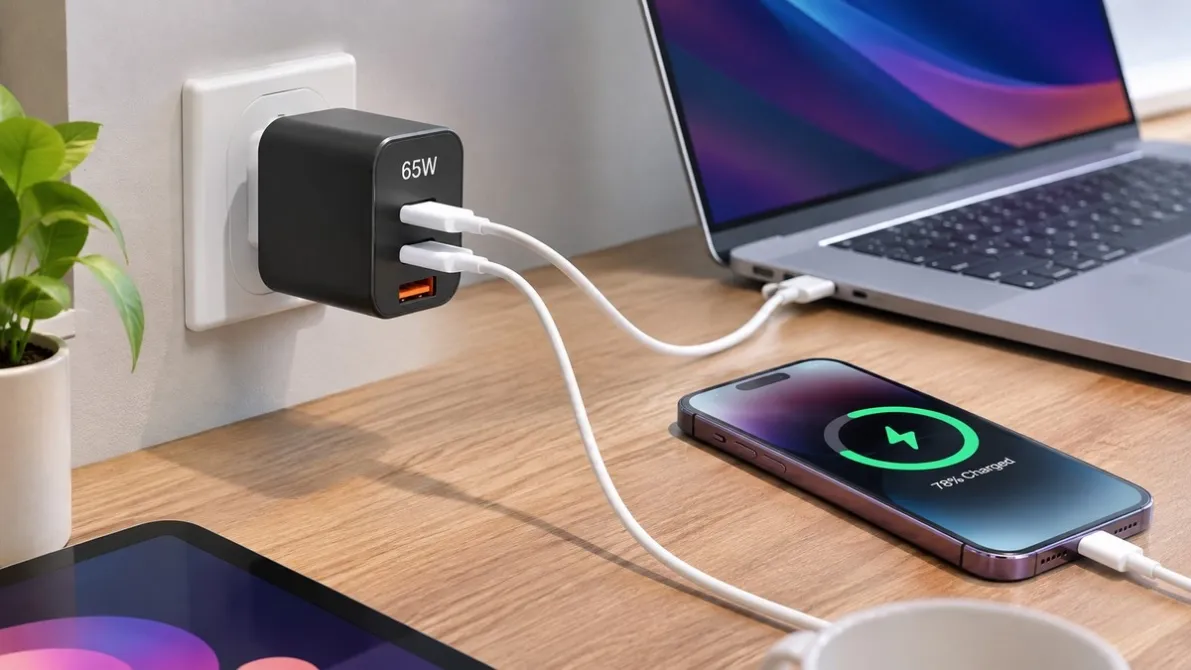
A customer is charging a phone with a 65W GaN charger. When a second device is connected, the phone stops charging for a moment and then starts again.
Is the charger defective?
Not necessarily. Some multi-port USB-C chargers briefly interrupt charging when they redistribute power between connected devices. This follows from how USB Power Delivery works: charging runs on a power contract negotiated between the charger and each device, and when the set of connected devices changes, the charger updates the power it can offer on each port and the contracts are renegotiated.
But repeated interruptions without any change in connected devices should be investigated.
For charger importers and private label brands, the difference matters. A product can meet its rated output and still create customer complaints if its power-sharing behaviour is not understood.
1. Why Does Charging Stop for a Moment?
Multi-port chargers have a limited total power budget.
Imagine a charger supplying 65W through USB-C1. When another device is connected to USB-C2, the charger may need to renegotiate power and assign a different output to each port.
Depending on the design, the first device may briefly disconnect and reconnect.
This is different from a charger that continuously loses power while the same devices remain connected.
2. Three Situations Buyers Should Distinguish
| Situation | What It May Mean | What to Check |
|---|---|---|
| Brief interruption when a second device is connected | Power renegotiation | Compare with the approved design specification |
| Repeated disconnects while connections remain unchanged | Possible compatibility, cable or charger fault | Repeat with known-good devices and cables |
| Charging stops under heavier load | Possible overload, protection or thermal behaviour | Check output profiles and protection response |
Do not assume every interruption is normal. The behaviour should match the agreed product specification.
3. A Practical Sample Test Before Ordering
Use the following sequence when evaluating a new multi-port charger.
Test A — Single-Port Output
Connect a compatible device to each charging port separately. Confirm the advertised voltage, current and charging function.
Test B — Port Switching
Keep one device charging. Connect a second device, then disconnect it. Record whether charging pauses, how the connected devices respond, and whether operation resumes normally.
Test C — Two-Device Stability
Keep both devices connected under a steady load. Watch for repeated resets, unexpected power loss or unstable output.
Test D — Different Cable and Device Combinations
Repeat the test with approved USB-C cables and different compatible devices. A cable or device issue can produce symptoms similar to a charger problem.
Test E — Confirm the Power Allocation Table
Compare the measured behaviour with the product's approved single-port and multi-port output specifications.
For example, Lirui's LR65ACC-EU-M02 65W GaN charger lists a USB-C1 + USB-C2 output allocation of 45W + 20W. This is a specification for that particular EU model, not a universal rule for all 65W chargers.
4. What Should Importers Agree With Their Supplier?
Before approving mass production, ask the supplier to confirm:
- The output available from each port
- The combined output for every supported port combination
- Whether short power interruptions occur when devices are connected or removed
- The expected behaviour under sustained multi-device charging
- The test devices, cables and conditions used for sample approval
Keep the agreed results with the approved sample.
This makes it much easier to investigate a complaint later.
Conclusion
A momentary charging interruption does not automatically mean a multi-port charger is defective.
The important question is whether the behaviour is expected, consistent and acceptable for the intended customers.
Testing port switching before a bulk order can help importers make better purchasing decisions and reduce avoidable after-sales disputes.
Related Product
For samples and OEM orders, kindly contact us.
References & Sources
- USB Implementers Forum. USB Charger (USB Power Delivery). https://www.usb.org/usb-charger-pd
- Lirui Electronics. 65W 2C1A GaN Charger — LR65ACC-EU-M02 Product Specifications. https://liruitech.com/products/wholesale-premium-65w-2c-1a-gan-fast-wall-charger
Source note: The testing steps are recommended buyer evaluation procedures, not published Lirui batch test results.