Charger Buzzing Noise: What Importers Should Check Before Bulk Shipment
Is a buzzing USB-C charger defective? Understand possible causes of coil whine and learn how importers can evaluate charger noise before approving bulk production.
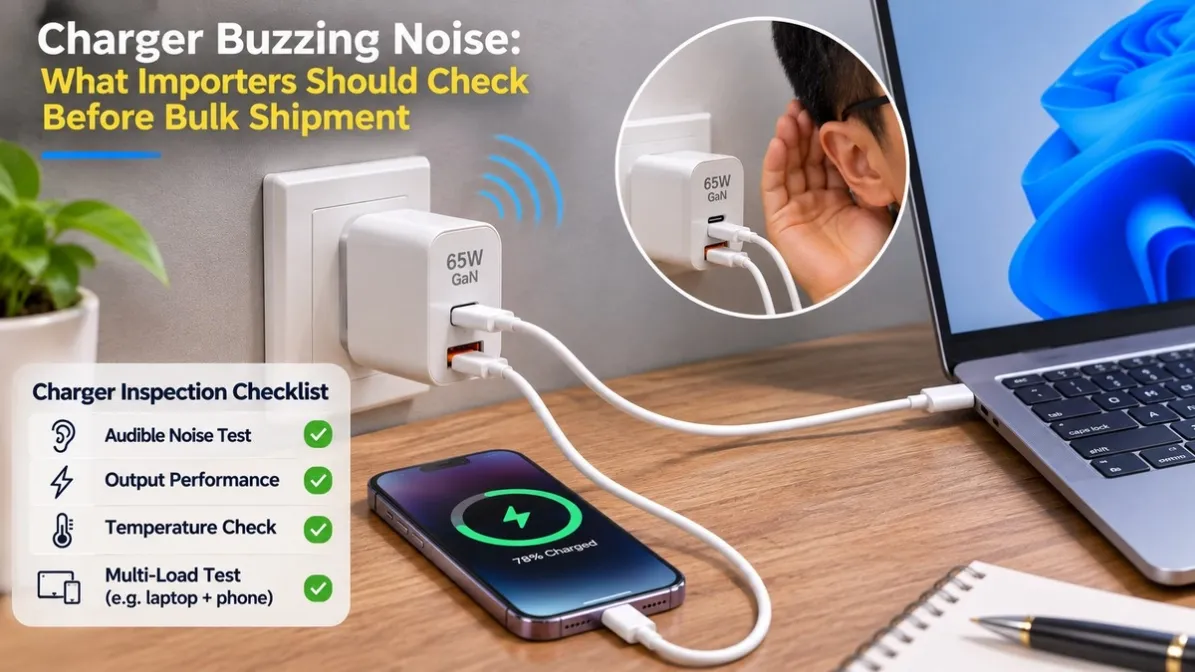
A practical approach to evaluating audible charger noise, sample quality and after-sales risk.
A wall charger may pass its basic charging test and still produce an irritating high-pitched noise.
Customers often describe it as buzzing, whining or a faint electrical sound.
For importers, the problem is not always easy to evaluate. A very faint sound under certain conditions may come from the normal operation of a switching power supply. A loud, changing or unusual sound may require further investigation.
The right approach is to evaluate both the sound and the charger's electrical performance.
1. What Causes Charger Coil Whine?
Switching power supplies contain components such as transformers and inductors.
Under some operating conditions, these components can vibrate at audible frequencies.
The sound may change with the charging load, switching behaviour or connected device.
It is important not to confuse a possible explanation with a quality conclusion. Hearing a noise does not identify its cause or prove that the charger is safe.
2. Why Basic Charging Tests Are Not Enough
A charger can show the correct output voltage during a brief test but produce an audible noise under another load.
For example, a sound may appear:
- With no device connected
- During low-power charging
- When the device is nearly fully charged
- Under a sustained higher load
- When switching between single-port and dual-port operation
These are suggested conditions to investigate, not claims about any particular Lirui charger.
3. How to Evaluate Charger Noise
Step 1 — Agree on the Test Environment
Test samples in a quiet room with a consistent background noise level. Keep the same listening position and distance for comparison.
Step 2 — Use Different Loads
Check no-load, light-load and rated operating conditions within the product's approved specification.
Step 3 — Compare Multiple Samples
A single quiet sample is not enough to establish mass-production consistency. Compare samples and record any noticeable variation.
Step 4 — Check Electrical Performance
Measure the relevant outputs and inspect for unusual temperature rise, repeated resets or abnormal operation.
Step 5 — Record the Result
Keep the sample ID, load condition, test position and observations. Audio recordings may support comparison, although phone recordings alone are not reliable calibrated noise measurements.
If the product is intended for quiet bedrooms, offices or bedside charging, agree on a practical acoustic acceptance criterion before mass production.
There is no universal audible-noise limit that applies to every charger, so the acceptance criterion has to be agreed for the specific product and its intended use.
4. When Should a Charger Be Rejected?
Treat unusually loud noise, worsening behaviour, abnormal heat, electrical smell, discoloration or unstable output as reasons to stop testing and investigate.
Do not continue using a charger that shows signs of overheating or electrical damage.
For OEM orders, a repeatable and documented acceptance standard is more useful than a vague statement such as "the charger sounds normal."
5. Questions to Ask Before Shipment
Ask your charger supplier:
Has audible noise been checked under different loads?
Were different production samples compared?
Does the production sample perform like the approved reference sample?
What happens if unusual buzzing appears during final inspection?
Can the supplier provide a documented corrective action if a problem is confirmed?
Conclusion
Charger noise should not be judged by sound alone.
For importers, the best protection is a clear sample approval process that combines acoustic observations, electrical testing and consistent production inspection.
This helps reduce uncertainty when customers report an unusual charger sound.
Related Products
For samples and OEM orders, kindly contact us.
References & Sources
- TDK Corporation. How to Use Power Inductors — application note on acoustic noise from magnetostriction and load-dependent switching behaviour in power inductors. https://product.tdk.com/en/products/inductor/inductor/smd/technote/power/apn-power-inductor.html
Source note: This article provides a proposed incoming-inspection method. It does not report measured noise levels, defect rates or test results for Lirui products.